
Why convertible issuance reached record levels in Q2 2026
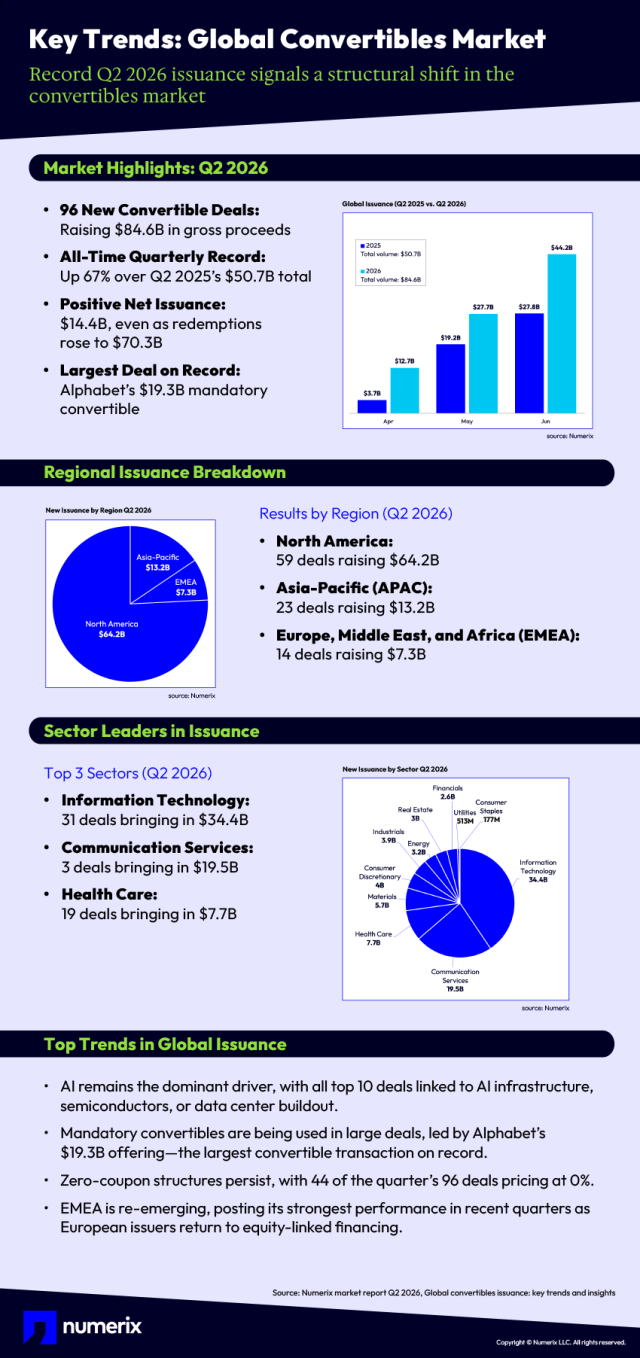
The global convertible securities market delivered its strongest quarter on record in Q2 2026, as issuance surged to historic highs against a backdrop of rallying equities and sustained investor demand. In the quarter, global issuance reached $84.6B across 96 deals, a 67% increase over Q2 2025 and the largest quarterly total ever recorded.
But the headline figures tell only part of the story. Anchored by Alphabet's $19.3B mandatory convertible—the largest convertible transaction on record—the quarter reflected a structural shift in how issuers are using equity-linked financing, with record breadth across sectors, regions, and deal sizes.
New research: breaking down Q2 trends
In our latest market report, Global convertibles issuance: Q2 2026 key trends and insights, we unpack the forces behind the record quarter — from sector-level dynamics and regional patterns to a closer look at the quarter's landmark transactions. Get a data-backed view of how convertibles are cementing their role as a primary funding channel in today's capital markets.
Key findings from the report are highlighted in the below infographic.
Strong returns reinforce investor demand
Record issuance arrived alongside a powerful equity rally. The ICE BofA US Convertible Index returned 16.78%1 during the quarter, while the S&P 500 gained 15.2%2, marking its strongest quarterly advance since Q2 2020. Convertibles captured that upside while retaining the downside protection that defines the asset class.
Elevated single-name volatility—the input that matters most for convertible pricing—was especially evident across the technology and AI sectors, further reinforcing investor appetite for the combination of equity participation and a defined bond floor. That dynamic continues to resonate in a risk-on market, particularly for investors seeking equity exposure with an asymmetric return profile.
AI becomes a dominant force in convertible issuance
The single most significant force behind issuance this quarter was the continued acceleration of AI-driven capital investment.
Information Technology led all sectors with $34.4B across 31 deals, driven by AI infrastructure buildout, semiconductor demand, and data center expansion. The financing wave extended from AI-native names to the hyperscalers themselves: all 10 of the quarter's largest deals—spanning Alphabet, CoreWeave, Super Micro Computer, Iren, Ciena, Lenovo, and Akamai—are tied to AI infrastructure, semiconductors, or data center buildout.
This concentration confirms a key evolution: the convertible market has become a primary funding channel for the AI capital cycle.
Large, strategic transactions take hold
Deal sizes in Q2 underscored the market's depth and maturity. 23 deals exceeded $1 billion, and all top 10 transactions priced at or above $1.75 billion—a new record for the quarter's largest deals.
Mandatory convertibles—securities that automatically convert into equity at maturity—are being used in large deals. Alphabet and Super Micro Computer together raised more than $23B in mandatory structures, following Oracle's $5.0B mandatory in Q1. Often tied to AI-related capital plans, mandatories are becoming an established tool for very large, strategic raises rather than a niche structure. Zero-coupon structures also persisted, with 44 of the quarter's 96 deals pricing at 0%, reflecting strikingly issuer-friendly terms at the top of the market.
Regional momentum expands the opportunity set
North America again led global volumes by a wide margin, raising $64.2B across 59 deals, powered by Alphabet's record deal and a deep bench of technology and AI-linked issuers.
Activity broadened meaningfully beyond North America. Asia-Pacific extended its year-on-year growth to $13.2B across 23 deals, spanning Japan, Taiwan, South Korea, Australia, and China. EMEA staged a marked re-emergence, raising $7.3B across 14 deals—its strongest performance in recent quarters and a sharp acceleration from the subdued issuance of late 2025 and early 2026. Together, the regional picture points to an increasingly global market rather than one concentrated in a single geography.
A supportive backdrop for continued issuance
With rate cuts deferred and policy remaining restrictive, the cost differential between convertibles and straight high-yield debt remains wide—positioning convertibles as an efficient financing alternative, particularly for issuers facing refinancing needs over the 2026–2027 maturity horizon. Even as redemptions rose to $70.3B, net issuance remained positive at $14.4B, extending the expansion of the convertible universe.
Looking ahead, the pipeline shows no sign of slowing. New deals continued to price globally in the opening days of Q3, and higher-for-longer rates, AI-driven capital intensity, and approaching refinancing needs all point to continued strength throughout the remainder of the year.
Explore the full Q2 2026 convertible market trends
Want the full picture behind this quarter's record issuance? Our latest report breaks down the key drivers shaping the market.
Download the full report: Global convertibles issuance: key trends and insights Q2 2026
¹ Source: ICE Data Indices, ICE BofA US Convertible Index, total return data as of June 30, 2026.
2 Source: Equity index performance (Q2 2026): S&P 500 total return (via S&P Dow Jones Indices). https://www.spglobal.com/spdji/en/indices/equity/sp-500/
Frequently Asked Questions
Q1. Why did global convertible bond issuance hit a record in Q2 2026?
Issuers turned to convertibles because they needed to fund large, capital-intensive projects—particularly AI infrastructure—more cheaply than straight high-yield debt while equity markets were rallying, and convertibles solved for both at once. Global convertible issuance reached $84.6 billion across 96 deals in Q2 2026, a 67% increase over Q2 2025 and the largest quarterly total ever recorded, according to the Numerix Global Convertibles Issuance Q2 2026 report. The quarter was anchored by Alphabet's $19.3 billion mandatory convertible, the largest convertible transaction on record, and 23 individual deals exceeded $1 billion.
Q2. What is the difference between financing with convertible bonds and straight high-yield debt in a higher-for-longer rate environment?
With rate cuts deferred and monetary policy still restrictive, straight high-yield debt carries elevated coupons that raise the cost of borrowing, which is the core problem convertibles address. Convertibles let issuers lower that financing cost by giving investors equity upside in exchange for a smaller or zero coupon—44 of the 96 deals in Q2 2026 priced at a 0% coupon, according to the Numerix Global Convertibles Issuance Q2 2026 report. That wide cost differential positions convertibles as an efficient financing alternative, particularly for issuers facing refinancing needs over the 2026–2027 maturity horizon.
Q3. How is the AI capital cycle driving convertible bond issuance?
AI infrastructure buildout, semiconductor demand, and data center expansion require enormous amounts of capital, and issuers are increasingly raising it through the convertible market. Information Technology led all sectors with $34.4 billion across 31 deals in Q2 2026, and all 10 of the quarter's largest deals—spanning Alphabet, CoreWeave, Super Micro Computer, Iren, Ciena, Lenovo, and Akamai—are tied to AI infrastructure, semiconductors, or data center buildout, according to the Numerix Global Convertibles Issuance Q2 2026 report. Mandatory convertibles have become an established tool for these large, strategic raises: Alphabet and Super Micro Computer together raised more than $23 billion in mandatory structures, confirming that convertibles are now a primary funding channel for the AI capital cycle.


