
How autocallables work: Income, protection and risk
Autocallables can offer attractive income opportunities, but these returns come with trade-offs. Our infographic below breaks down how they work in six simple steps.
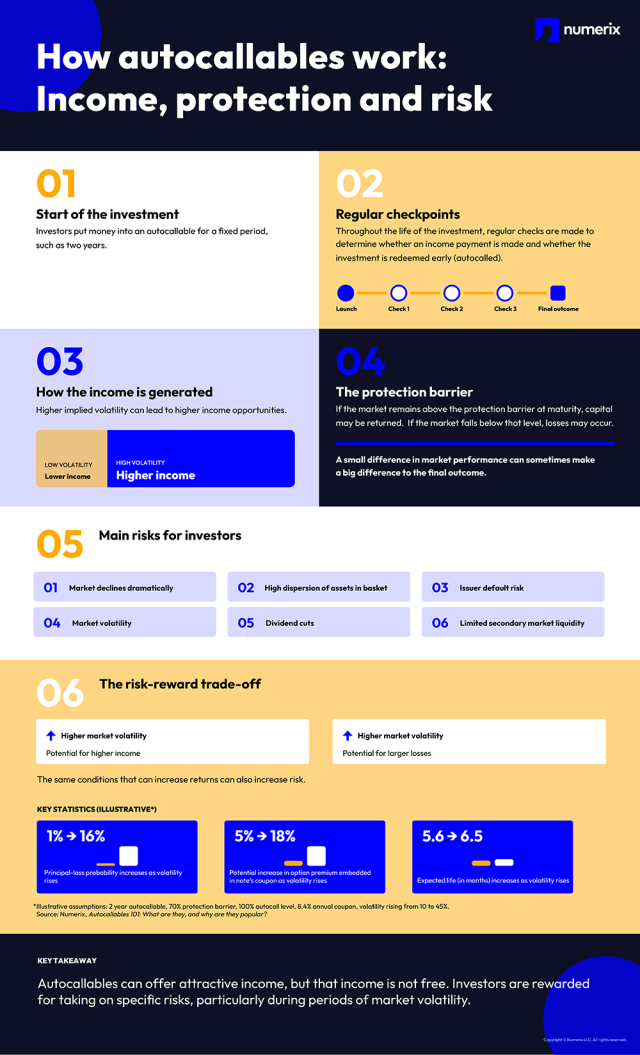
The basics
An autocallable is a structured investment with a defined term, often two years or more. During the life of the investment, a series of observation dates determine whether investors receive an income payment and whether the product may be redeemed early.
Where the income comes from
The income available on an autocallable is closely linked to market volatility. When market uncertainty is low, potential income tends to be lower. When volatility rises, potential income generally increases. Put simply, investors are compensated for taking on greater uncertainty and risk.
Understanding the protection barrier
Many autocallables include a protection barrier that helps buffer investors from moderate market declines. If the underlying market remains above the barrier at maturity, investors may receive their original capital back. If it falls below the barrier, losses can occur. As a result, relatively small differences in market performance can sometimes lead to significantly different investment outcomes.
The risk-reward trade-off
Volatility is a double-edged sword. Higher volatility can increase the income available from an autocallable, but it can also increase the likelihood and severity of losses. The same market conditions that make these products more attractive from an income perspective can also make them riskier.
Our illustrative example highlights this relationship:
- The probability of loss increases from 1% to 16% as volatility rises.
- The potential option premium increases from 5% to 18% over the same range.
The takeaway
Autocallables are designed to reward investors for taking on specific risks, particularly during periods of heightened market uncertainty. Understanding how income, protection features, and risks interact is essential before making an investment decision.
What's driving the income potential of an autocallable? Read our white paper, Autocallables 101: What are they, and why are they popular? which breaks down how these products are built, how yield is generated, and why they have become a popular investment solution.
Frequently Asked Questions
Q1: How do investors know when an autocallable will pay income or be redeemed early?
Investors often struggle to predict when an autocallable will pay out or end, because the outcome depends on the market rather than a fixed schedule. An autocallable is a structured investment with a defined term, often two years or more. During that term, a series of observation dates determines whether the investor receives an income payment and whether the product may be redeemed early. Each observation date is therefore a checkpoint that links market performance to the income and early redemption outcome.
Q2: How does a protection barrier work on an autocallable, and what happens if the market falls below it?
Investors in autocallables are exposed to market declines, and the protection barrier is the feature designed to buffer moderate ones. Many autocallables include a protection barrier. If the underlying market remains above the barrier at maturity, investors may receive their original capital back. If it falls below the barrier, losses can occur. As a result, relatively small differences in market performance can sometimes lead to significantly different investment outcomes.
Q3: How much more risk of loss comes with the higher income that volatility creates on an autocallable?
Investors drawn to higher autocallable income often overlook that the volatility generating it also raises the risk of loss. Autocallable income is closely linked to market volatility: potential income tends to be lower when uncertainty is low and generally higher when volatility rises, because investors are compensated for taking on greater uncertainty and risk. In our illustrative example, the potential option premium increases from 5% to 18% as volatility rises, while the probability of loss increases from 1% to 16% over the same range. The same market conditions that make an autocallable more attractive from an income perspective can also make it riskier.

