
One investment. Three possible outcomes
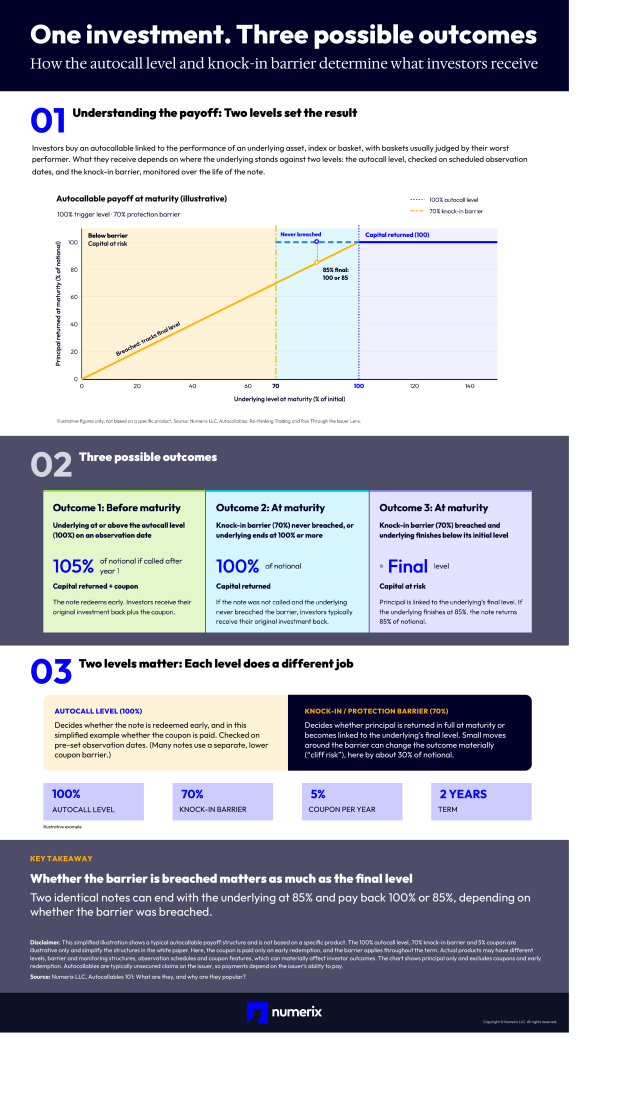
Autocallables are popular because the proposition is simple: enhanced income in exchange for capped upside and conditional downside risk. But the same product can produce very different outcomes. This infographic shows how a 100% autocall trigger and a 70% protection barrier determine whether an investor is repaid early, receives full capital at maturity, or incurs a loss.
New to autocallables? Read our white paper: Autocallables 101: What are they, and why are they popular?
Frequently Asked Questions
Q1. How do investors know whether an autocallable note will redeem early, return full capital, or lose money?
Investors often struggle to see how one autocallable can produce three different results. According to Numerix's Autocallables 101 infographic, the outcome depends on where the underlying stands against two levels: the autocall level, checked on scheduled observation dates, and the knock-in barrier, monitored over the note's life. In its 100% autocall, 70% barrier example, the note either redeems early with a coupon, returns 100% of notional at maturity, or returns the underlying's final level.
Q2. What is the difference between the autocall level and the knock-in barrier in an autocallable note?
Investors often treat the two thresholds as one, but each does a different job. According to Numerix's Autocallables 101 infographic, the autocall level (100% in its example) is checked on pre-set observation dates and decides whether the note redeems early. The knock-in barrier (70%) decides whether principal is repaid in full at maturity or becomes linked to the underlying's final level. For baskets, the worst performer is usually the reference, and many notes add a separate, lower coupon barrier.
Q3. How much can a knock-in barrier breach change what an investor receives at maturity on an autocallable?
Small moves around the barrier can change an autocallable's payoff sharply, a feature known as cliff risk. In the illustrative Numerix Autocallables 101 example (100% autocall level, 70% knock-in barrier, 5% annual coupon, 2-year term), a note whose underlying ends at 85% returns 100% of notional if the barrier was never breached, but only 85% if it was. The gap at the barrier is about 30% of notional. The example is simplified and not a specific product.


