
Autocallables 101: Why the market's favorite income structure is also one of its most path-dependent
Autocallables have become one of the most popular structures in the equity-linked products market. According to Structured Retail Products (SRP), autocallable formats such as Athena and Phoenix structures accounted for more than half of total structured product sales volumes in Europe in 2025, underscoring their dominance within the market1.
Their appeal is straightforward: investors can earn enhanced coupons in exchange for capping some upside participation and accepting conditional downside risk. With clearly defined terms, observable triggers, and yields that often exceed those available from traditional cash instruments of similar maturity, the proposition is easy to understand.
What is less obvious is where that yield comes from. An autocallable is an equity-linked structured note that may be redeemed early if the underlying asset reaches a predefined call level. The structure typically offers enhanced coupons in exchange for limiting upside participation through the autocall feature and exposing investors to downside risk if the underlying falls below a specified protection barrier2. As a result, outcomes depend on more than the final level of the underlying asset. The path taken along the way can be just as important. An investor can experience materially different outcomes for two different underlying paths, even when the underlying asset finishes at the same price.
This path dependency is what makes autocallables both powerful and complex. Their valuation, risk profile, and performance are shaped by market direction, volatility, timing, and the interaction of multiple observation dates throughout the life of the trade.
The autocall feature shortens the note, and the risk
On pre-set observation dates, an autocallable may redeem automatically if the underlying is at or above a specified trigger. When it does, investors typically receive notional plus any coupon due for that period. If not, the contract simply continues to the next observation date3.
Realized life can be far shorter than legal maturity. Under a standard two-year structure with monthly observations and an at-the-money autocall level, expected life is typically well under legal maturity, often closer to six months than twenty-four at moderate volatility assumptions. This is attractive when reinvestment opportunities are good, and considerably less so when yields have fallen, since reinvestment risk is easy to underweight at inception.
Product design choices matter more than they first appear. Lowering the autocall level raises the call probability and reinvestment uncertainty. Setting the coupon barrier below the autocall level lets coupons accrue on dates when the note does not redeem, adding more income and more path dependence. Step-down structures, where the autocall level declines over time, deliberately increase the chance of early redemption as the note ages4.
Volatility is both the opportunity and the risk
Volatility is a key determinant of autocallable valuation and behaviour. Deng, Mallett and McCann (2011) show that the probability of early redemption is a central component of autocallable pricing and can be estimated across successive call dates. Albuquerque, Gaspar and Michel (2015) found that autocallables are commonly issued on underlying assets exhibiting high volatility and show that incorporating stochastic volatility assumptions can materially affect valuation results5.
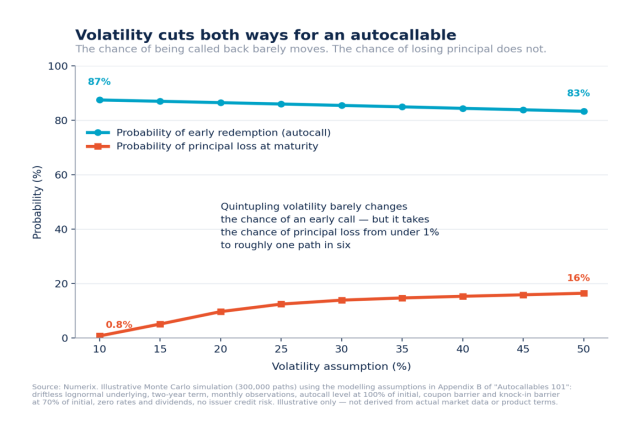
These effects are not equal. While higher volatility may modestly improve the economics available at issuance, it can have a far more significant impact on the downside risk profile once the trade is live.
Figure 1. Volatility is more of a capital risk than a call risk
Cliff risk is more than a disclosure issue
Many autocallable structures incorporate barrier features alongside the autocall mechanism. These features are linked to the performance of the underlying asset and can affect investor outcomes at maturity, while the autocall feature itself may be evaluated on either discrete or continuous observation dates6.
If the barrier is never breached, investors may receive full principal repayment even if the underlying finishes below its initial level. If the barrier is breached, however, the payoff can shift abruptly, with investors participating in losses based on the asset's final value.
Figure 2. Principal redemption depends on the path taken and the ending level
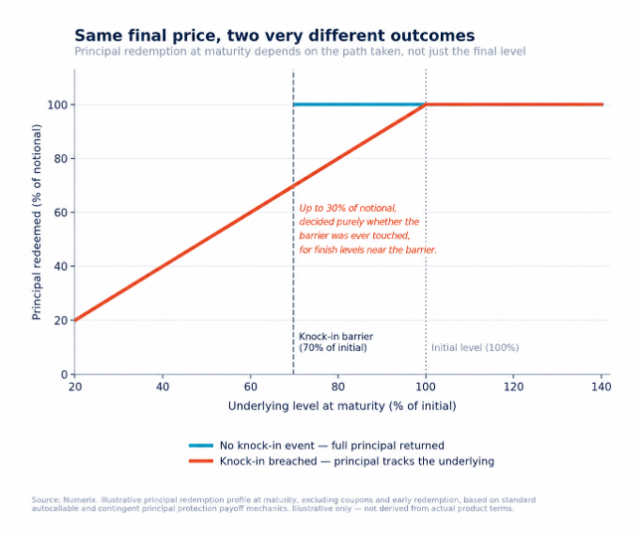
This discontinuity is the essence of autocallable risk. Consider an underlying that finishes at 75% of its initial value. If the barrier was never breached, the investor may recover 100% of principal. If it dipped below the 70% barrier at some point before recovering to finish at 75%, redemption falls to 75% of principal. A single barrier event can therefore create a meaningful gap in outcome, up to 30 percentage points at the limit, even though the final asset price is identical in both cases.
Understanding an autocallable requires more than knowing where the underlying ends. Investors must also consider the path it takes. Small changes in market behavior around the barrier level can have a disproportionate impact on returns, and even the choice of monitoring convention can materially alter the probability of loss.
This path dependency places autocallables much closer to portfolios of Bermudan and barrier options than to simpler income strategies such as covered calls or cash-secured put writing7. Their value and risk profile are highly sensitive to assumptions about volatility dynamics and the conditional probabilities of barrier events. In worst-of basket structures, the dependence structure and relative performance dispersion between constituents become critical drivers as well8.
What this means in practice
Autocallables can be an effective solution for investors seeking defined income in markets that are expected to remain broadly range-bound or rise modestly over time. In these environments, the structure can efficiently convert option premium into enhanced yield. What it is not designed to do is behave like a traditional bond during periods of severe market stress, nor is it an optimal vehicle for expressing a strongly bullish view. The same mechanism that generates income also limits participation in sustained upside, as the note is typically called away when the underlying performs well9.
For professional investors, the key question is usually how autocallables are implemented, rather than whether they belong in a portfolio. Managing the risks requires looking beyond headline coupon levels to the underlying drivers of return. Diversifying across reference assets, maturities, and observation schedules can help reduce concentrations of barrier risk. Stress testing path dependent outcomes, assessing liquidity under adverse conditions, and incorporating appropriate hedging strategies are equally important considerations.
All figures illustrate the directionality of effects under simplified assumptions. They omit skew, volatility term structure, discrete versus continuous monitoring conventions, financing, and issuer credit risk, and are not predictions of realized outcomes.
Gain further insight
The headline coupon is easy to understand, but the embedded risks may not be. Read Autocallables 101: What are they, and why are they popular? for a practical guide to one of the market's most widely used structured products, including the key drivers of performance, the impact of volatility, and why path dependency sits at the heart of autocallable investing.
1SRP. Europe 2025: autocallables dominate, thematic and rates strategies evolve
4Liedholm, C. F. (2015). A risk- and performance study of financial structured products (master's thesis); Vähämäki, S. (2023). Simulating structured investment product performance: an empirical study (master's thesis).
5Deng, G., Mallett, J., & McCann, C. (2011). Modeling autocallable structured products. Journal of Derivatives & Hedge Funds, 17, 326–340; Albuquerque, R. A., Gaspar, R. M., & Michel, A. (2015). Investment analysis of autocallable contingent income securities. Financial Analysts Journal, 71(3), 61–83.
6Deng, G., Mallett, J., & McCann, C. (2011). Modeling autocallable structured products. Journal of Derivatives & Hedge Funds, 17, 326–340; Liedholm, C. F. (2015). A risk- and performance study of financial structured products (master's thesis)
9Albuquerque, R. A., Gaspar, R. M., & Michel, A. (2015). Investment analysis of autocallable contingent income securities. Financial Analysts Journal, 71(3), 61–83; Vähämäki, S. (2023). Simulating structured investment product performance: an empirical study (master's thesis).
Frequently Asked Questions
1. How do institutional investors assess downside risk in autocallable notes when the final level of the underlying does not determine the payoff?
Two autocallables can finish at the same underlying level and repay materially different amounts, because outcomes depend on the path taken, not just the endpoint. Consider a note with a 70% barrier where the underlying finishes at 75% of its initial level. If the barrier was never breached, the investor may recover 100% of principal. If it dipped below 70% before recovering, redemption falls to 75%. A single barrier event can create a gap of up to 30 percentage points. The monitoring convention, discrete versus continuous, also materially alters loss probability.
2. What is the difference between an autocallable note and a covered call or cash-secured put strategy for generating enhanced income?
Investors often group autocallables with covered calls or cash-secured put writing because all three convert option premium into yield, but the risk profiles diverge sharply. Autocallables embed discrete autocall triggers and downside barriers, placing them closer to portfolios of Bermudan and barrier options than to simple premium-selling strategies. Their value depends on volatility dynamics and the conditional probability of barrier events rather than a single terminal payoff. Worst-of basket structures introduce a further driver: the dependence structure and performance dispersion between constituents.
3. How much shorter than legal maturity is the expected life of a typical two-year autocallable with monthly observations?
Investors frequently size autocallable allocations against legal maturity, which overstates how long the exposure actually lasts. Under a standard two-year structure with monthly observations and an at-the-money autocall level, expected life at moderate volatility assumptions is typically closer to six months than twenty-four. This compression is attractive when reinvestment opportunities are strong and costly when yields have fallen. Design choices amplify it. Lowering the autocall level raises call probability, and step-down structures deliberately increase early redemption likelihood as the note ages.

