
Beyond stress testing: Building resilience for Asia's next market shock
For many financial institutions, stress testing has become a familiar and essential component of risk management. Regulatory requirements, quarterly reviews, and annual exercises help firms evaluate how trading books might perform under adverse market conditions. But in today's environment, simply passing a stress test may no longer be enough.
Across Asia, risk leaders are confronting a new reality. Crises are becoming more complex, more interconnected, and more difficult to anticipate. Geopolitical tensions, market volatility, policy shifts, liquidity shocks, and technological disruptions can rapidly combine in ways that traditional stress testing frameworks were never designed to capture.
As a result, many institutions are expanding their focus from testing resilience to actively rehearsing it. This is where scenario war-gaming is emerging as the next evolution of risk management.
Borrowed from the military, but built for markets
War-gaming originated in military and strategic planning, where participants are placed in a hypothetical crisis to identify weaknesses in a plan before they become real problems. In a financial context, the same principle applies, institutions simulate a market shock and assess its effects across the organization. This includes analysing how portfolio values change, where liquidity pressures emerge, whether hedging strategies remain effective, whether margin obligations can be met, and whether teams across trading, risk, and treasury maintain a shared and timely understanding of the situation.
The point is not to guess the next headline correctly. It is to build the reflexes and the playbook so that when something disrupts markets, the response is not created under pressure. Done continuously, it functions like a fire drill, where everyone already knows their exit before the alarm sounds.
Real-world scenarios that make the case for war-gaming
Asia has lived through shocks that make the case for continuous war-gaming better than any hypothetical scenario could.
Contagion that ignores fundamentals
When Thailand abandoned its currency peg on 2 July 1997, the resulting devaluation of the baht triggered a crisis that quickly spread beyond its borders. By October 24, market forces led the baht to depreciate by 60% against the US dollar1. As investor confidence deteriorated, capital flowed rapidly out of neighbouring markets, placing intense pressure on currencies including the Philippine peso and Indonesian rupiah.
What began as a country-specific event soon evolved into a regional crisis, as investors treated many Asian economies as a single risk exposure rather than distinguishing between individual market fundamental2.
Figure 1: Regional contagion triggered a sudden reversal in capital flows
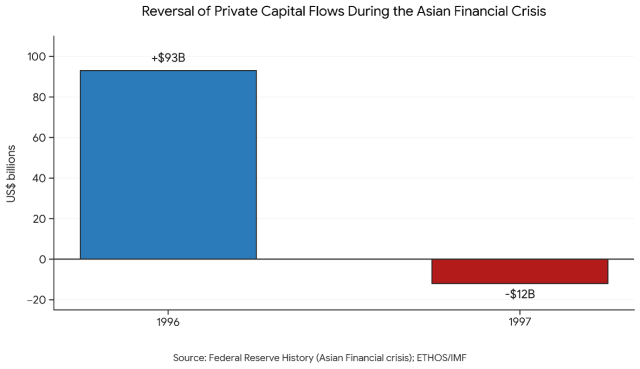
A well-designed war-gaming exercise that modelled regional contagion — not simply a Thai currency devaluation, but a broader loss of confidence across Asian markets — could have highlighted the risk of correlations converging under stress. Such a scenario would have helped institutions understand how seemingly independent exposures could quickly become linked when investors moved to reduce risk across the region simultaneously.
Intervention that backfires
After the Shanghai and Shenzhen equity markets suffered sharp declines during the summer of 2015 — falling approximately 32% and 40% respectively within weeks — Chinese authorities introduced a circuit-breaker mechanism intended to curb panic selling and restore market stability3 4.
When markets came under renewed pressure in January 2016, however, the mechanism produced the opposite effect. Trading halts were triggered almost immediately on two separate occasions, prompting investors to sell even faster in anticipation of market closures.
Following widespread criticism that the policy was amplifying rather than dampening volatility, regulators suspended the circuit breakers after only four trading days5 6 .
This episode highlights the importance of testing for behavioural and second-order effects. A control that appears effective in theory may alter incentives and market behaviour in ways that exacerbate stress. Robust stress testing frameworks therefore assess not only direct market impacts but also how investors, counterparties, and other market participants are likely to respond under extreme conditions.
Credit stress that starts in one balance sheet and spreads to the system
In August 2021, Evergrande warned Guangdong officials of a looming cash shortage, providing an early indication that one of China's largest property developers was struggling to meet its financial obligations. What initially appeared to be a company-specific liquidity problem soon escalated into one of the largest corporate defaults in modern history, involving liabilities of more than US$300 billion7.
The effects did not stop with Evergrande. As concerns over the developer's solvency intensified, stress spread across China's property sector. Home sales weakened, property prices came under pressure, developer financing conditions deteriorated, and bond investors reassessed credit risk across the industry. Over time, attention shifted beyond developers themselves to the institutions exposed to the sector, including regional banks and other lenders8. The sequence illustrates how financial stress can move through interconnected markets and balance sheets.
A traditional counterparty default scenario may capture the immediate impact of a single firm's failure. However, effective stress testing should also examine how losses can propagate through adjacent sectors, funding markets, and financial institutions over time. Continuously updated scenarios are better suited to identifying these second- and third-order effects, whereas a one-off annual exercise conducted before the initial warning signs emerge may fail to capture the broader contagion pathway9.
Figure 2: Evergrande's default triggered a multi-year contagion across China’s financial system.
| Date | Stress event | Impact |
| Aug 2021 | Evergrande warns officials of looming cash crunch | Early liquidity stress signal |
| Sep-Dec 2021 | Debt payments missed and default concerns intensify | Counterparty default risk emerges |
| 2022 | Property sales weaken; home prices come under pressure | Real estate sector stress |
| 2022-202 | Developer bond markets deteriorate | Credit market contagion |
| 2023-2024 | Regional banks face rising property-related exposures | Banking sector transmission |
Source: Reuters. China Evergrande’s snowballing debt crisis. August 27, 2021.
The gap in most current playbooks
Most stress testing frameworks in the region were built around regulatory anchors including Basel-aligned liquidity and capital requirements, and HKMA (Hong Kong Monetary Authority) and MAS (Monetary Authority of Singapore) supervisory reviews10. While these regulatory-focused frameworks ensured a baseline of resilience, they were not designed to capture region-specific contagion dynamics, intervention side effects, or cross-asset leverage unwinds on their own. War-gaming these scenarios continuously, rather than waiting for the next scheduled regulatory review, is the key to closing this gap.
Why continuous stress testing matters
None of these events looked alike, and the next one will not resemble any of them precisely in magnitude, scope or sequencing. This is exactly the argument for war-gaming. Rather than expecting any single rehearsed scenario to repeat itself, firms should regularly practice working through contagion, feedback loops, and leveraged unwinds so they can respond faster and with more discipline when a real crisis emerges.
For institutions operating across APAC time zones simultaneously, this discipline is not optional. It is the difference between entering a crisis with clear escalation paths, tested liquidity options, and coordinated risk actions, or entering it still trying to reconcile exposures, align decision-makers, and improvise under pressure while capital, clients, and confidence are already at risk.
Risk leaders and their boards should now move beyond periodic assurance and make crisis rehearsal a standing management discipline, embedded in governance, liquidity planning, and day-to-day risk decision-making before the next shock forces the test.
Are you preparing for the next crisis, or the last one? Traditional stress tests can quickly become outdated. Read our white paper Beyond quarterly stress testing: Continuous scenario analysis for portfolio resilience to learn how continuous scenario analysis can help firms identify emerging risks and build resilience before the next disruption occurs.
1 Federal Reserve Bank of San Francisco. Lessons from Thailand. Ramon Moreno. November 9, 1997.
2 Federal Reserve History. Asian Financial Crisis. July 1997-December 1998
4 BIS Bulletin. The market turbulence and carry trade unwind of August 2024. No. 90, 2024.
5 BIS Bulletin. The market turbulence and carry trade unwind of August 2024. No. 90, 2024.
6 BIS Bulletin. The market turbulence and carry trade unwind of August 2024. No. 90, 2024.
7 Global Financial Systems. Chapter 6. Asian Crisis of 1997 and the IMF.
8 IMF. The Asia Crisis: Causes, Policy Responses, and Outcomes. Andrew Berg. October 1, 1999.
9 IMF. The Asia Crisis: Causes, Policy Responses, and Outcomes. Andrew Berg. October 1, 1999.
10Regulatory & Supervisory Framework. Hong Kong Monetary Authority,
Frequently Asked Questions
1. What is scenario war-gaming, and how is it different from traditional stress testing?
War-gaming, a concept borrowed from military planning, places an institution inside a simulated market shock and tracks its effects across the whole organization — how portfolio values move, where liquidity pressure builds, whether hedges still work, whether margin calls can be met, and whether trading, risk, and treasury teams share a common view of the situation in real-time. Traditional stress testing tends to be a periodic, regulatory-driven check; war-gaming is a continuous rehearsal designed to build reflexes and a ready playbook, not just to produce a pass/fail result.
2. Why isn't passing a regulatory stress test enough anymore?
Today's shocks are more complex, interconnected, and harder to predict — geopolitical tensions, market volatility, policy shifts, liquidity crunches, and technology disruptions can combine quickly in ways legacy stress frameworks were not built to capture. Most existing frameworks are anchored to Basel-aligned capital and liquidity rules and supervisory reviews (e.g., HKMA, MAS), which establish a baseline of resilience but were not designed to capture region-specific contagion, the side effects of market interventions, or cross-asset leverage unwinds.
3. What historical examples show why continuous war-gaming matters in Asia? Three episodes make the case. The 1997 Thai baht devaluation, which spread into a regional crisis as investors treated Asian markets as a single risk exposure rather than assessing each on its own fundamentals; China's 2015–16 circuit-breaker experience, where a stabilization mechanism intended to curb panic selling instead accelerated it, showing the importance of testing for behavioral and second-order effects; and Evergrande's 2021 liquidity warning, which escalated into a US$300+ billion default and spread stress across China's property sector and its lenders, illustrating how losses propagate through interconnected balance sheets over time.


